08 July 2011

"Little Dog knew he wasn't and never had been lost." ChLA 2

I wouldn't be me if I didn't "play hooky" or "cut class" now and then. 
Learning from the Left: Children's Literature, the Cold War, and Radical Politics in the United States Friday morning at ChLA, I slept in because I needed time to recover from the awful travel day on Wednesday and the late night on Thursday.  The late morning  put me at the coffee bar with key note speaker Julia Mickenberg, Assoc. Prof. American Studies at U.T. Austin, who authored one of the books I read in preparation for the the conference.  Learning from the Left: Children's Literature, the Cold War, and Radical Politics in the United States won the 2008 ChLA Book Award and is a beautifully written "study of children's literature and the Left in the mid-twentieth century.  It is a work of history as well as a work of literary analysis." (p. vii) 
I  was born at mid-20th century and, as a child, read many of the books discussed.   I thanked Julia for her book "which explained my life."  As a child I learned a democratic, egalitarian spirit from the books I read.  "While school textbooks taught children to uphold the values of the Cold War, many of the trade books they checked out of the library or bought in bookstores taught them just the opposite."     As McCarthyism drove leftist writers and educators underground they entered "the hidden world" of children's literature.  Some titles and authors mentioned in the book are:
Millions of Cats (Gift Edition) (Picture Puffin Books)The Little Red Caboose (Little Golden Book)Millions of Cats, Dr. Seuss, the All- About Books and the Landmark Books, Jack London, Little Golden Books, Penny Parker, Nancy Drew,  most Lincoln biographies for children, Langston Hughes (whose poetry I selected as my reading for UIL competition during my senior year in high school), many science and nature books, etc.  
Meet Abraham Lincoln (Landmark Books)"Few..." of the authors of these books "wished to 'propagandize' children...  they wished to make children autonomous, critical thinkers who questioned authority and believed in social justice.... to strengthen a sense of community, of the need to work with others to solve problems or accomplish tasks."  (page 11)  "They wished to give children tools of critical thinking, a distrust of received authority, and insights into the dynamics of biological and technological development and operation.  They wanted to share their internationalist, cooperative, and democratic outlook and what they perceived as an ability to rationally evaluate aspects of an irrational society."  (p. 182)   
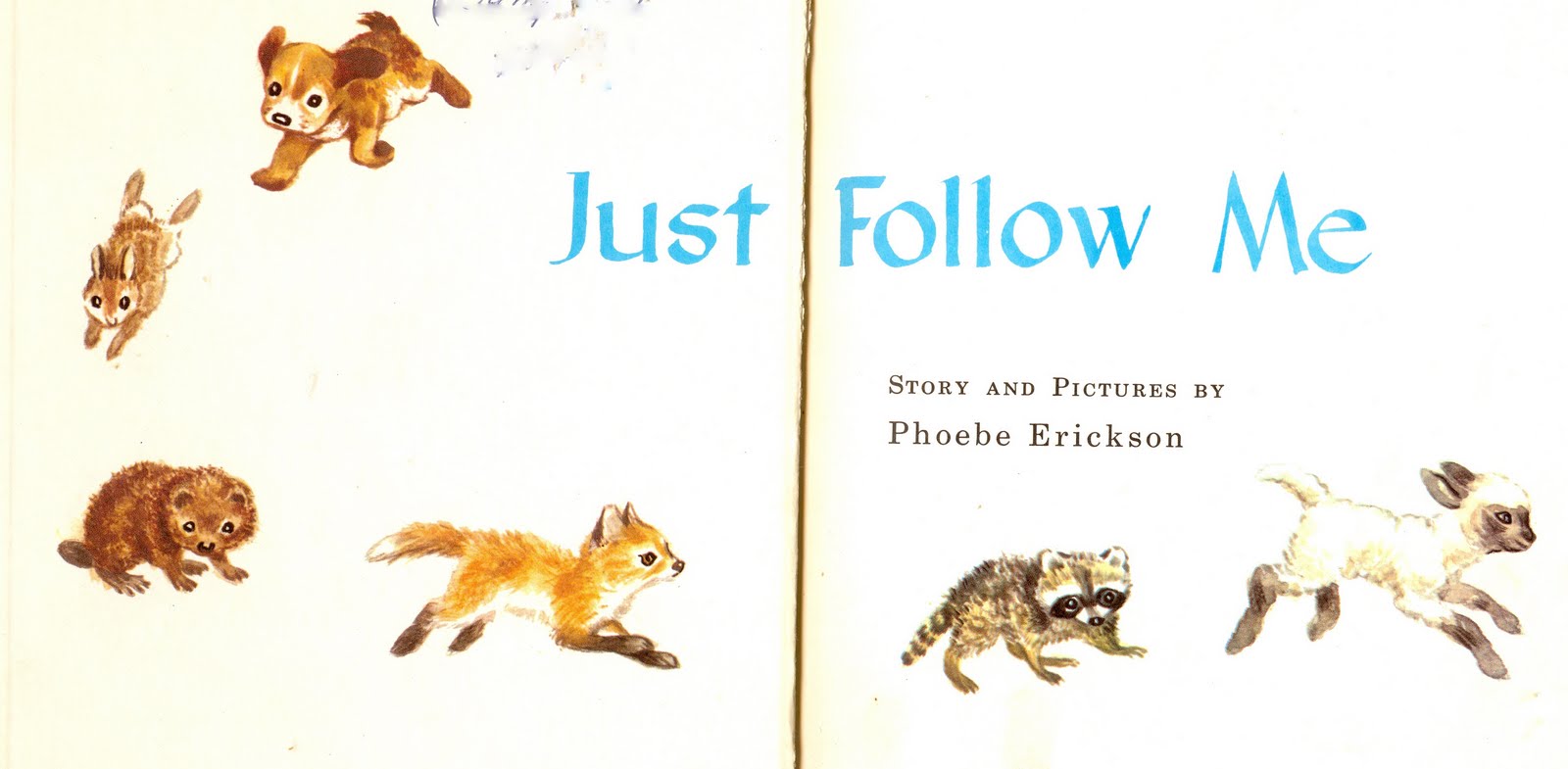
While I was reading this book, I was selecting books from my sister's library and came across Just Follow Me by Phoebe Erickson which is illustrative of Mickenberg's treatise:  the puppy explores a world that is much bigger than he is, meets a variety of animals who say "just follow me" while he learns to judge for himself what is and isn't a home, comes across a lamb from the flock of the home farm, plays equally with this very different animal, and goes home to a mother who has worried that he has been lost but "Little Dog knew he wasn't and never had been lost."  
In some sense this little book is a biography of the "flower children" and so many of my friends who travelled about and made foolish and wise choices while "looking for themselves" during our college years.   It is one explanation of how and why the radicalism of the 1960s grew out of the placid (and repressive) 1950s and how and why some children of the South marched for Civil Rights, although Julia cautions:  "It would be impossible (and far too reductive) to draw some kind of cause-and-effect link between childhood reading and the rebellions of the 1960s. Even so, the generational lines are not merely coincidental." p. 276

I highly recommend Mickenberg's Learning from the Left, which I read in the Kindle edition, to anyone with an interest in literature, history, American culture, education, or who seeks to understand the roots of the sharp political divide and partisanism which is the bane of current U.S. politics.  We might also read a some children's literature to see if we can  "strengthen a sense of community, of the need to work with others to solve problems."

01 July 2011

"Windows and Wallpaper" ChLA 1

I recently spent a delightful 5 days at Hollins University attending  ChLA; the hosts were wonderful, the sessions were educational, my fellow attendees were interesting and interested, the food was delicious, and there were fireflies at the awards banquet on the grounds of the historic quad.  All that and I got to be dorm "roomie" with Sonya Sawyer Fritz.  What fun!

The Runaway BunnyMargaret Wise Brown, who graduated from Hollins in 1932, is the author of two of my favorite books (Goodnight Moon and The Runaway Bunny)
and is being celebrated with a festival which has just opened.  The campus museum exhibit, where I spent a delightful half hour and wanted to stay the day, is Goodnight, Hush.  Classic Children's Book Illustrations. I lingered and returned again and again to the original illustrations by Clement Hurd.  Since DMP and I had a series of house bunnies spanning twenty years, I delighted in his studies of rabbits in various poses.

Papa Gatto: An Italian Fairy TaleI also enjoyed the classic fairy tale illustrations of Ruth Sanderson and bought a copy of Papa Gatto, An Italian Fairy Tale, a Cinderella story which required no fairy godmother. 
GoldilocksSanderson's illustrations are beautiful and draw one into the story.  If there had been a copy in stock I would have bought Goldilocks because the illustration reminds me of my young neighbor, Emily C.  After making my purchase, I returned to the exhibit to find the benches fully occupied by women with PhDs and tenure-track professorships.  Each had grabbed a book and settled down to read a story of her childhood. What a wonderful recess from the distractions of scholarship!

Word WizardThe first session on Thursday featured Children's Literature as Linguistic Play and a look at books where "conversation shapes social reality" and  I enjoyed learning about these very special children's books:  Max's Words, The Three Pigs David Wiesner's The Three Pigs at first seems to be the familiar story  but then the wolf huffs & puffs & blows the little pigs outside the story frame and away they go on a series of adventures (and changing illustrative style) into other story books.  It's a childhood version of Jasper Fforde's Thursday Next series which neither DMP nor I can resist for a minute.
The Eyre Affair: A Thursday Next Novel (Thursday Next Novels (Penguin Books))Lost in a Good Book: A Thursday Next NovelOne of Our Thursdays Is Missing: A Novel

The Hero with a Thousand Faces: Commemorative Edition (Bollingen Series (General))The Wonderful Wizard of Oz (Original Version)Adam Z. Dotson's presentation linked Frank Baum's The Wonderful Wizard of Oz to Joseph Campbell's The Hero with a Thousand Faces which defined the monomyth and has been required reading for any serious student of literature since it was first published in 1949.  A bit of fun as Dorothy manages all 17 points of the hero's journey although Baum's work predates Campbell's by almost half a century.  If you only know the movie, you've missed much of the story although I did not much enjoy the books when I read them as a child.  

Dotson's paper was lagniappe since I chose that panel because I wanted to hear Anna Panszczyk's paper "Get Thee to a Library:  The Library Setting as a Space of Revolt and Difference in Children's Literature" and Anna did not disappoint.  The library appears as a space of "hushed tones and rigid rules" where one obtains "immediate information" but its  "organized, ordered exterior" exists "in tension with the chaos at its heart" where there is a "frenzied passion" to "collect, hoard, and devour" books.  Anna's talk featured  Library Lion and The Librarian of Basra   and one of the most delightful books I've come across, The Libraryby Sarah Stewart about a girl who would "rather read..."  That girl is a lot like the child I was and the woman I grew to be.
The LibraryLibrary LionThe Librarian of Basra: A True Story from Iraq

The day concluded with a screening of The Library of the Early Mind, a documentary film directed by Edward J. Delaney, produced by Steven Withrow, which features interviews with 50 top writers, illustrators, publishers and critics of children's literature.

{Insert many adjectives for a rave review here!}

 The interview with Daniel Handler a.k.a. Lemony Snicket is a delight!

One of the interviewees (perhaps Peter H. Reynolds) said that children's literature, "the books we read as children... give us windows and wallpaper."  I think he meant "windows" through which to look out and learn of the world and "wallpaper" with which to decorate the rooms of our minds, the images on which our inner eye dwells. 
My quirky mind was pleased at what I think was an unintended double entendre:  Windows is also an operating system and Wallpaper is the image we select for our Desktop. One cannot consider books, reading, information, libraries without considering the changes that technology and digitization are bringing. 
Quoting my friend Luci's blog:  "...if you're a teacher... start imagining how you can transition your classroom to a multi-media, online format. don't worry, your organization's LMS should be a great help, and you can shoot for gradual blended learning if the online component freaks you out. but buck up, soldier - the technology is here to stay, people are already drawn to it, and it can add a lot of options to your class to help different kinds of learners, so make friends with the computer and let it help us turn out critical thinkers who're actively participating in their educations."

ChLA to be continued...

30 May 2011

A novel, a blog, and Bob Dylan

I can't seem to get back into the blogging groove.  I can't even keep Library Thing updated with my "what I'm reading" and "recently read" lists.  I have been reading as much as I can manage; I'm cramming for ChLA like I think it's a final exam.  When the program came out, I was pleasantly surprised to find that I was better read in the source material than I had anticipated.  I'll save those books and my comments for the July blog after I've come home.


The HelpSEASONS (my women-reading-theology group) has decided to offer a special summer program based on the book and soon to be released movie, The Help by Kathryn Stockett which I read on Kindle.  I will probably blog much more about this book later also.  I'll limit today's comment to Stockett's decision to break the novel's timeline in order to include the lyric of Bob Dylan's The times they are achangin'. On page 352, Skeeter hears the song on the car radio. "It is better than anything I've ever heard... I feel a rush of inexplicable relief.  I feel I've just heard something from the future."  The novel is set in 1962 and Dylan's song was first played 26 October 1963.  I don't understand why Stockett didn't just push her timeline.  A later date would have allowed her to make use of the selective service draft which throughout most of the South took "coloreds and white trash" first. The conscription and death of young black men "in the white man's war" in Viet Nam served as a call to action for the civil rights movement.  I, however, did not write this book; the teller of the tale gets to make such decisions.  I basically liked The Help and thought it spoke truth.

My reading of Stockett's book came shortly before Bob Dylan's  70th birthday so I revisited the music of my youth.  As I recall I first heard Bob Dylan on the floor of my dorm room probably in the fall of 1968.  I had to learn to appreciate Dylan as a musician--it was a totally new sound--but I recognized at once that he was a great poet.  Malcolm Guite--British poet, singer-songwriter, and priest--writes a blog which I enjoy for its insight on the intersections of literature and Christianity.  In a 2008 article published in The Tablet, Malcolm Guite demonstrates how Dylan layers time and echoes biblical text. 
Turning again to the song that Stockett thought so essential to her story that she broke the timeline to quote the last two lines of the first stanza, I have added a few notes in red in The times they are a-changin' by Bob Dylan:

Come gather 'round people
Wherever you roam
And admit that the waters       whelming waters                      
Around you have grown
And accept it that soon
You'll be drenched to the bone
If your time to you                  "redeeming the time"
Is worth savin'
Then you better start swimmin'  rejection of status quo
Or you'll sink like a stone        Jesus: "better a millstone"
For the times they are a-changin'.


Come writers and critics       Stockett's novel is about writing
Who prophesize with your pen
And keep your eyes wide
The chance won't come again
And don't speak too soon     there is a long silence, time of waiting
For the wheel's still in spin  Bible is not the only religion's imagery
And there's no tellin' who
That it's namin'                    who is named in Skeeter's book
For the loser now                  Jesus:  last shall be first
Will be later to win
For the times they are a-changin'.


Come senators, congressmen    Stuart's father is a senator
Please heed the call                   Hilly's husband is running for office
Don't stand in the doorway       Hilly's husband loses election
Don't block up the hall              Stuart's father has more open views
For he that gets hurt                  but will not speak them publicly
Will be he who has stalled
There's a battle outside
And it is ragin'
It'll soon shake your windows
And rattle your walls
For the times they are a-changin'.


Come mothers and fathers       lots of mothers in novel
Throughout the land
And don't criticize                   Skeeter's mom & Elizabeth criticize
What you can't understand
Your sons and your daughters
Are beyond your command
Your old road is                     Psalm 1, the way of the wicked
Rapidly agin'
Please get out of the new one   road blocks to stop activists
If you can't lend your hand
For the times they are a-changin'.


The line it is drawn         novel is all about boundaries
The curse it is cast          this image is about prophecy
The slow one now
Will later be fast
As the present now
Will later be past
The order is
Rapidly fadin'
And the first one now       again Jesus: last shall be first
Will later be last
For the times they are a-changin'.


[ Lyrics from: http://www.lyricsmode.com/lyrics/]

listen to Bob Dylan at the White House Celebration of Music of the Civil Rights Movement.