Showing posts with label children literature. Show all posts

01 November 2013

My Library: Children's Books Written and Illustrated by Women


Victoria Ford Smith's delightful blog re. children's books written and illustrated by women prompted me to visit my library where I have quite a stack of such books, many of them the favorites I gleaned from my sister's collection when she retired from teaching 1st grade.

It's no surprise that I saved Nancy Smiler Levinson's Clara and the Bookwagon. Harper & Row, 1988. Illustrations by Carolyn Croll. This book tells the story of the "country's first traveling bookwagon" which Mary Lemist Titcomb, head of the public library in Hagerstown, MD, designed in 1905. Joshua Thomas, the library janitor, drove Miss Titcomb and hundreds of books through 500 square miles of back country roads. A small bit of history with themes of reading and literacy are to be expected but this little gem also dances about the child as part of the rural labor force. "Books are for rich people... Farm people like us do not have time to read."

Another book about books, reading, writing, and libraries that found a spot on my library's shelf was Katie Cleminson's, Otto The Book Bear. New York: Disney Hyperion Books, 2011. When no one is looking Otto leaves his book's pages to go exploring but one day his book is moved and he is left behind--a very small bear all alone in a very big world. "And just when he thought he couldn't walk any farther, when he felt cold and tired, Otto saw a place full of light and hope. He went inside and found...rows and rows of books!" What reader has not known the joy of a library where we find as Otto did "book creatures just like him?" Award-winning Katie Cleminson's other books include:  Magic Box; Cuddle Up, Goodnight, Box of Tricks, Wake Up. I love this book!

The Midnight Farm is the first children's book published by Reeve Lindbergh in 1987 and illustrated with the heartbreakingly beautiful paintings of Susan Jeffers. The First Puffin Pied Piper Printing (1995) graces my shelves. "Here is the dark when the day is done, Here is the dark with no moon or sun, Here is the dark when the lights are out, Here is the heart of the dark." You can take a look at this book via Amazon. Both Lindbergh and Jeffers have many other books. Jeffers, in particular, is worth exploring. Written for a child who was afraid of the dark, this book makes me feel happy and cozy and safe.


 I have the 1993 edition of Monique Felix's The Colors which has been reissued.  The delightful Mouse Books are books without words "designed to excite a child's imagination, develop verbal skills, and foster an interest in reading. Each beautifully illustrated book allows a child to create a story while learning an important skill."  A sad little mouse gnaws through the page of a book and discovers a box of paints. What a joy! to sit and listen to the story a 4-7 year old tells as they turn page after page of beautiful illustrations. There is an entire series of Mouse Books and Monique Felix has illustrated a number of other books written by others; those have words although not always as much imagination.

Not every library has a whole shelf dedicated to books about rabbits. Yes, rabbits--from Beatrix Potter classics to tacky Easter basket books. I suppose it started when we had house rabbits as pets. I've never met a kid, especially a boy who could resist this book, although several of the girls have found it "creepy" or have wanted to color the pictures. I bought Miriam Schlein's Snake Fights, Rabbit Fights, & More. A Book about Animal Fighting. New York: Crown Publishing, Inc., 1979 with its beautiful and accurate illustrations by Sue Thompson because I couldn't resist the spot-on drawings of cottontails, so like the sweet Christopher that David found drowning in a ditch in Leon County, TX, and I bottle fed. We intended to release him into the wild but with  misaligned  teeth he would not have survived. So we kept him and he was very smart and very brave and oh-so-destructive. I could write a book...


 Mary Batten writes excellent nature books for children and her Baby Wolf is one of the best! Published by Grosset & Dunlap, New York, 1998, the illustrations by Jo Ellen McAllister Stammen are better than any photos or documentary. It's a lovely true story about family and growing up and being part of a community and surviving and ecology. I love the honesty of the moose hunt where the wolves kill and eat. This is a "science reader" and children who read such books cannot help but love science and care deeply about the environment. Don't miss the chance to take a look at the first few pages with this link to Amazon. Stammen's illustrations are great nature art full of atmosphere and movement.

And now for something completely different. Susan Meddaugh's Cinderella's Rat. Boston: Houghton Mifflin, 1997. The prolific Meddaugh offers a retelling of the classic fairy tale from the rat/coachman's point of view. "I was born a rat. I expected to be a rat all my days. But life is full of surprises." This delightful book is also full of surprises.

Not enough women writers and illustrators receive awards but When I Was Young in the Mountains by Cynthia Rylant, illustrated by Diane Goode, New York: E. P. Dutton, 1982, is a Caldecott Honor Book. Rylant authored  Newbery Medal-winning Missing May, the Newbery Honor Book A Fine White Dust, and two Caldecott Honor-winning picture books: Relatives Came and When I Was Young in the Mountains. "When I was young in the mountains, we went to church in the schoolhouse on Sundays, and sometimes walked with the congregation through the cow pasture to the dark swimming hole, for baptisms. My cousin Peter was laid back into the water, and his white shirt stuck to him, and my Grandmother cried." It is rare to find a book, a children's book, that mentions baptism especially "believer's baptism by immersion" as practiced both by the Baptist Church in which I grew up and by the Church of Christ (Stone-Campbell movement) in which I have spent my adult life. Those pages always warm my heart a bit.  Diane Goode's illustration evoke the mist of memory with warmth and whimsy. One of my favorite books. This book is like listening to your grandmother tell stories.  If you click the titles you can enjoy the preview at Amazon.  

It is tragic that this beautiful book by George Ella Lyon with illustrations by Vera Rosenberry is out of print. Together was first published in 1989. The paperback 1994 edition (New York: Orchard Paperbacks) is a delight to have on my shelves.  Rosenberry's watercolor illustrations bring this poem to life joyfully, exuberantly, radiantly. The book is about two girls--one black, one white--who together share childhood play and imaginative adventure. The girls are a delight as they engage in physical activity of the sort that is all too often limited to the "dangerous" play of boys. It is, of course, a beautiful book about friendship  and child agency and imagination but it is so much more. The repeated refrain, "Let's put our heads together and dream the same dream," evokes the speech of Dr. Martin Luther King and offers readers of all ages joyful hope that soars like the girls on the back of birds in the final illustration.

"You bring the cheese and I'll fetch the mouse."

 The author's website is well worth a visit. This book should be back in print!

17 June 2013

ChLA 2013 Building a Career in Children's Literature

Just back from a wonderful conference in Biloxi, Mississippi hosted by the University of Southern Mississippi. I offer the first of several blogs I'm planning on the panels I attended and the books I read pre-conference. My blogging has been spotty of late, and I'm hoping to get back in the literary groove. I select this first topic because a friend asked me to take a few notes to share because she could not attend the Friday morning panel chaired by Amanda Allen, Eastern Michigan University. There were four panelists and these notes should be viewed as my impressions rather than their remarks unless I indicate otherwise by the use of quotation marks:


  1. Richard Flynn, Georgia Southern University, "Stepping on Cracks: Applying, Teaching, and Publishing Across the Children's Lit/Adult Lit Divide"  emphasized that it is essential to be proactive in establishing a scholarly record. Publish! ...In today's job market, it is "misguided to focus exclusively" on children's, Y.A., or Adult literature. "Be diverse. Try to place your children's literature critiques in other venues." These practices help you establish networks of support and enhance your reputation and increase your likelihood of success.
  2. Martin Woodside, Rutgers University, "All Work and No Play?: Balancing the Personal and the Professional." Calypso Editor, the youngest person on the panel, parent of young child/children, reminded us "you're responsible for putting all these balls in the air...." Don't create too much distance between work and play.  It's easy to complain but "this was my choice...." "Spending time with a real child" (yours!) "can be an important asset" in children's literature.... Balance is both "respect and perspective" and "it's OK to be frustrated." Do one thing at a time, focus on what you need to do, be fully present wherever you are. "Spending time with my family" makes "me a better worker" ...it's OK to leave some things undone...." His examples applied to both personal and professional life. "The opposite of play is not work; it's depression."
  3. Erica Hately, Queensland University of Technology, "Risky Business: International Job Hunting" emphasized that there are both "international" and "institutional" cultures and that the job hunt involves translating not just into another language but into another culture. "You must also translate yourself." Understand the culture you are going to, be excited by it. Things that help you find and keep a job are your ability to "attract funding"...and publish, noting that the type of publications matters a great deal. "Book chapters..." Seek a "niche" that gets you noticed.
  4. Roberta Seelinger Trites, Illinois State University, "Playing at Professionalism: Facing Down Impostor Syndrome" delivered a talk that was quite entertaining as well as helpful. She began "whenever I feel afraid, I whistle a happy tune..." "Impostor Syndrome is normal..." As one acquires knowledge, and realizes how much one does not yet know, one begins to "feel inadequate" and to feel like "an impostor." Remember, each of us is always learning; you are "a student your entire life." Don't pad the c.v. or puff up yourself because "it's a sin to lie" but it is always OK to admit that you don't know and to assert what you do know.  "Not knowing everything does not mean you're incompetent." Assess your strengths and weaknesses. "Focus on your comfort zone" because that is where you can work most happily and achieve most quickly. Assess your weaknesses and work to develop those areas more slowly. Nobody is good at everything. Celebrate your successes, "even your small ones...." "Tell 5 people about your success... most people like hearing your good news." Give yourself permission to seek validation. Be proud of your accomplishments. Diversify your career. Set goals and meet them. Reward yourself. Celebrate with your true friends. {As an aside, she spoke of "toxic competitiveness..." among individuals and within an academic department and  "a concern for status" as leading to Impostor Syndrome. Humility is an antidote to Impostor Syndrome. She pointed out that even a successful academic may need therapy or counseling to deal with life issues. Get help from a mental health professional if you need it.} Focus on your own achievements. Do not compare yourself to others. "...find the playful in everything you do..." As Martin said, "you chose this." At play you don't feel an impostor. Compartmentalize! If you're grading, go into a room and grade. If you're having Thanksgiving dinner with your family and sitting around visiting over pumpkin pie and coffee, enjoy being with your family; grade some other time. "Multi-tasking is a delusion."
In Q&A  I did not identify either the questioner or the responder. Hitting the highlights:

  • c.v. is a genre, master it. Ask to see a friend's application packet
  • in publishing a recommendation is a help in the submission process... note your readers' reports... REWRITE!!! Do not send out anything that someone senior to you has not read... Have at least two readers, one senior to you and one just a little bit senior to you, read your material before submission.
  • write out of a place of passion.
  • If an editor sends you a "revise and resubmit" that does not mean "oh, they don't like it." Rather it means that they want to work with you. Everything goes through multiple revisions. Trust the journal editor who wants to help you, to work with you to get you published.
  • Where to go for help? The panel agreed that "Ph.D. advisor is a life time relationship." Talk to those you meet at conferences and talk to you after your presentation. Contact a recent scholar working in a related area. Ask, ask, ask... "people know how to say No... or they should."
  • create a narrative for yourself. Charting your goals and your progress is helpful but telling your story and revising it every few years may also be helpful (This from the audience.)
  • There is always something that is "the hardest" to do. If at all possible I make it a rule to "give it priority"  "when the mood is right..." For example when I can write poetry, I try to write poetry rather than giving other things priority. Sometimes one must stop juggling and focus. (This from Martin.)
  • The time between revision and publishing? "How long is a piece of string?" (That from Roberta) 14 months, 2 years, up to 3 years Be productive. Be prolific. Be patient.
  • If you are going to work in children's literature, you must be able to articulate why children's literature matters. Write a paragraph about why your genre matters. Practice saying it with authority. Look for common ground with others... play the diversity card... "everyone was once a child" yet children are often oppressed, ignored, devalued...
  • How does tenure change your experience? Now I have "freedom to speak..." now I am expected to be and am "a leader..." now I am "an administrator..." and "now I'm stuck here..." "now what?" There is always something problematic about every institution...
  • Next year we need a panel on mid-career issues.
  • Roberta: Remember, "It's a job.  A job!" ..."40 hours of work/week" which all the panelists agreed may not be possible which is one reason that at least some aspects of your work must be play--something that brings pleasure, something that brings energy, something that  brings laughter and joy. "But it is a job... It's not your identity." Commit to the personal relationships that give your life meaning. 
Although I don't really have a career in children's literature, this was one of my favorite panels. Much of this advice is applicable to anyone in any career or stage of life. My gratitude to the speakers.

ChLA Children's Literature Association

04 August 2011

"the mutable meaning of a supposedly immutable book"


Last Sunday in the Open Door class at Southwest Central, my dear friend ABCE read a portion of Isaiah from the King James Bible.  I found it hard to follow although it would probably have been much easier if I had just listened to her beautiful voice and phrasing.  I'm no mean Elizabethan scholar having devoted 5+ semesters to it at Rice.  I grew up on KJV;  it's the text that often comes first to my memory thanks to my dear great aunt, Helen Calahan Karr, and sword drills at South Plains Baptist Church. 
In many ways it is the best translation of the Psalms in English--still after 400 years. 
The New English Bible with the ApocryphaA few weeks ago I went with some church friends and my mother-in-law to the Dunham Bible Museum at Houston Baptist University.  Touring the museum it's very easy to see that it is "God" who is "the same yesterday, today, and tomorrow" because it is most certainly not biblical text which changes transmission mode (oral, written, digital) and media (stone, animal skin scroll, papyrus folio, paper & ink, printing press) and language (Hebrew, Aramaic, Greek, Latin, English, and countless others) over centuries.  People's interaction with text changes, too.  It's fun to revisit discussions of what is and what is not part of the canon.  People change  as societies and as individuals, as I learned when when I was trying to track the text in my New English Bible (Oxford University Press, 1970) while Andrea read her KJV.  Even her Bible looks little like the edition that first came off Gutenberg's press.  Some of the more modern versions read by other class members are just so simple that I worry about lost meanings, missing sub-texts, and literary structures that have been rendered invisible.

The Secret GardenIn odd moments, I've been turning these things over in my mind probably because of a ChLA 2011 session which I chose only because I'd lingered too long over morning coffee and conversation and it was being presented in the classroom next door. 

"Evolving Cultural Images in Illustrated Books" was a hodge-podge panel with environment/nature books and a lovely presentation by Anne Phillips on illustration in The Secret Garden by Frances Hodgson Burnett entitled "Crocuses, Robins, and Rosebuds" and her presentation was a charming as her title.
However, the presentation that has lingered in my thoughts was Benjamin Lindquist's "The Evolving Images of Kenneth N. Taylor's Illustrated Children's Bibles"  which looked at examples from 1956, 1989, and 2002.  He began with a quote and I missed the cite: "books are more than the words they contain."  Starting with a rather gruesome picture of Absalom that his wife (and I) remembered from childhood Sunday School, Lindquist showed examples of how biblical illustrations, especially those for children, were softened and sentimentalized throughout the 20th Century.   Taylor's Children's Bibles used the same text over fifty years while changing illustrations in each new edition "reflect[ed] inarticulated social assumptions." 

The New Testament in Pictured for Little EyesThe Bible in Pictures for Little EyesThe books themselves changed from large books which format, paper, and font size indicate are intended to be read to a child by an adult to smaller books, thicker paper, larger font sizes--books that are "child friendly" and which the child might access for herself.  The illustrations change from "high art" to sentimental art to cartoonish drawings lacking perspective. 

The New Bible in Pictures for Little EyesThe change represents more than a change in artistic style; it reflects societal views of childhood, of parental authority, of the place of worship, of God.  The age of child characters frequently became younger, encouraging a little child to insert himself into the more adult text.  Such changes also make the Bible more like every other book on the child's shelf or in the toy box.  Is it possible that some of these changes undercut the Bible  as a "book like no other" and as "the word of God"?  Since such books and their pictures are "the child's first introduction to the divine, to the practice of religion," Lindquist proposes that it is well to consider the "mutable meaning of a supposedly immutable book." 

Using the story of Samuel's waking in the night to God's voice calling him, Lindquist showed how these changing illustrations change the reader's view and introduce a changing theology.  In the earliest illustration Samuel's experience is mediated by Eli and a transcendent God is visibly present in items of scroll and Temple lamps and in the moon & starlit sky of His creation.  By 2002, Eli is left out of the picture and a very young Samuel himself pulls back a curtain of the Temple  There is no scroll, implying that Samuel's experience is not subject to scripture.  There are no items of worship.  If God is represented, it is only by Samuel's own glowing face and the source of light is not clearly defined as external or internal to Samuel's self. 

I'll never again look at Bible illustrations in the way I once did.

 He also showed some Sunday School hand-out illustrations from 1925 and the print that hung in my bedroom as I was growing up. 

It's from an 1890  painting by Heinrich Hofmann; the colors in our print were somewhat faded from exposure to the light.  Even as a very young child, I loved this print.  I suppose it was an icon for me;  it encouraged me in my daily Bible readings and called me to prayer.  If I woke up frightened in the night, I'd shine my flash light on it and be comforted.  The print remained on the wall of the bedroom when I went to college, but still today when I turn off the lights and close my eyes, I think of it.  It's still calls me to prayer.  It's still a comfort to me.

And while I'm on the subject of biblical illustration, I want to share a couple of other favorites:

Frances Hook.       Soft and Sweet.

                Timothy Botts.  The text is the illustration.
Frances Hook Picture Book/R2868Doorposts
The Dore Bible IllustrationsAnd the 19th Century favorite, Gustav Dore.

22 July 2011

"Words are our most inexhaustible source of magic."

Harry Potter & Deathly Hallows Part 2DMP and I went today to see Harry Potter:  The Deadly Hallows, Part 2.  We read/loved/lived the books and were very pleased with the movies.  To quote DMP:  DHpt1 was  "confusing, meandering, dark and just really not a very good movie but I thought the same thing about the first part of the  book."  This final episode redeemed Part 1 and was a very satisfying conclusion to the story.  In some ways, Part 2 wins the rare accolade:  It was better than the book. 

It's always interesting to see the changes that are made in going from print to screen. Spoiler alert here:  perhaps my favorite moment in the movie is when Neville Longbottom pulls out the sword of Gryffindor and the movie gave that bit a much better heroic frame than the book.  But then, the actor who played Neville has developed quite satisfactorily; at least in my view.  I have an ingrained attraction to the nerd as romantic lead.   
I also thought the conversation at King's Cross was better in the movie than the book and I wonder if Rowling didn't write it with the movie visuals in mind. My favorite line from the movie--"Words are our most inexhaustible source of magic."--do not appear in the book; at least not that I remember and I didn't find them when I re-read that last couple of chapters of the book.
 A similar line from the book (page 209):  "And his knowledge is incomplete...  That which Valdemort does not value, he takes no trouble to comprehend.  Of house-elves and children's tales, of love, loyalty, and innoncence, Voldemort knows and understands nothing.  Nothing. That they all have a power beyond his own, a power beyond the reach of any magic, is a truth he has never grasped."

The Collected Works of Frances Hodgson Burnett: 35 Books and Short Stories in One Volume (Unexpurgated Edition) (Halcyon Classics)That reference to "children's tales" is a good point to turn this blog to the final installment of ChLA 2011.  Since it relates to the movie I'll begin with Friday's session on Reading, Education, and Girl's Development.  Caroline McAlister presented a paper on "Bookworm as Heroine from Frances Hodgson Burnett to J.K. Rowling."  McAlister cited Shakespeare's McBeth:  "a woman's story at a winter's fire, authorized by her granddam."  She discussed a Burnett heroine: "if reading is the source of her isolation, it is also her way back into the public world."  She traces an arc from the "passive habit of reading" which leads to empathy which leads to active citizenship, a sympathetic responsiveness to others.  She explains this as "the training of the imagination."  This arc is in fact the goal of all didactic writers whether Harriet Beecher Stower, C. S. Lewis, George McDonald, or my dearly beloved Evelyn Whitaker.

Hermione Granger is another example of one whose passive reading leads to active citizenship, in particular her concern for the house elves. Q&A was dyanmic:   Are Hermione's concerns due to her reading, her inherently sympathetic nature as female, or her humanity?  Hermione is a muggle and one presumes attended muggle schools and knows muggle history.  There are also some concerns that in the Rowling books "there is no literature--no one reads anything but text books" or books in search of information. This observation is quite disturbing, given that the Harry Potter books are credited with saving books and promoting literacy.   Literacy is not necessarily literature; literature is part of what makes us human.   We live a world that increasingly values "knowledge.. incomplete... takes no trouble to comprehend... children's tales... which have... power."

08 July 2011

"Little Dog knew he wasn't and never had been lost." ChLA 2

I wouldn't be me if I didn't "play hooky" or "cut class" now and then. 
Learning from the Left: Children's Literature, the Cold War, and Radical Politics in the United States Friday morning at ChLA, I slept in because I needed time to recover from the awful travel day on Wednesday and the late night on Thursday.  The late morning  put me at the coffee bar with key note speaker Julia Mickenberg, Assoc. Prof. American Studies at U.T. Austin, who authored one of the books I read in preparation for the the conference.  Learning from the Left: Children's Literature, the Cold War, and Radical Politics in the United States won the 2008 ChLA Book Award and is a beautifully written "study of children's literature and the Left in the mid-twentieth century.  It is a work of history as well as a work of literary analysis." (p. vii) 
I  was born at mid-20th century and, as a child, read many of the books discussed.   I thanked Julia for her book "which explained my life."  As a child I learned a democratic, egalitarian spirit from the books I read.  "While school textbooks taught children to uphold the values of the Cold War, many of the trade books they checked out of the library or bought in bookstores taught them just the opposite."     As McCarthyism drove leftist writers and educators underground they entered "the hidden world" of children's literature.  Some titles and authors mentioned in the book are:
Millions of Cats (Gift Edition) (Picture Puffin Books)The Little Red Caboose (Little Golden Book)Millions of Cats, Dr. Seuss, the All- About Books and the Landmark Books, Jack London, Little Golden Books, Penny Parker, Nancy Drew,  most Lincoln biographies for children, Langston Hughes (whose poetry I selected as my reading for UIL competition during my senior year in high school), many science and nature books, etc.  
Meet Abraham Lincoln (Landmark Books)"Few..." of the authors of these books "wished to 'propagandize' children...  they wished to make children autonomous, critical thinkers who questioned authority and believed in social justice.... to strengthen a sense of community, of the need to work with others to solve problems or accomplish tasks."  (page 11)  "They wished to give children tools of critical thinking, a distrust of received authority, and insights into the dynamics of biological and technological development and operation.  They wanted to share their internationalist, cooperative, and democratic outlook and what they perceived as an ability to rationally evaluate aspects of an irrational society."  (p. 182)   
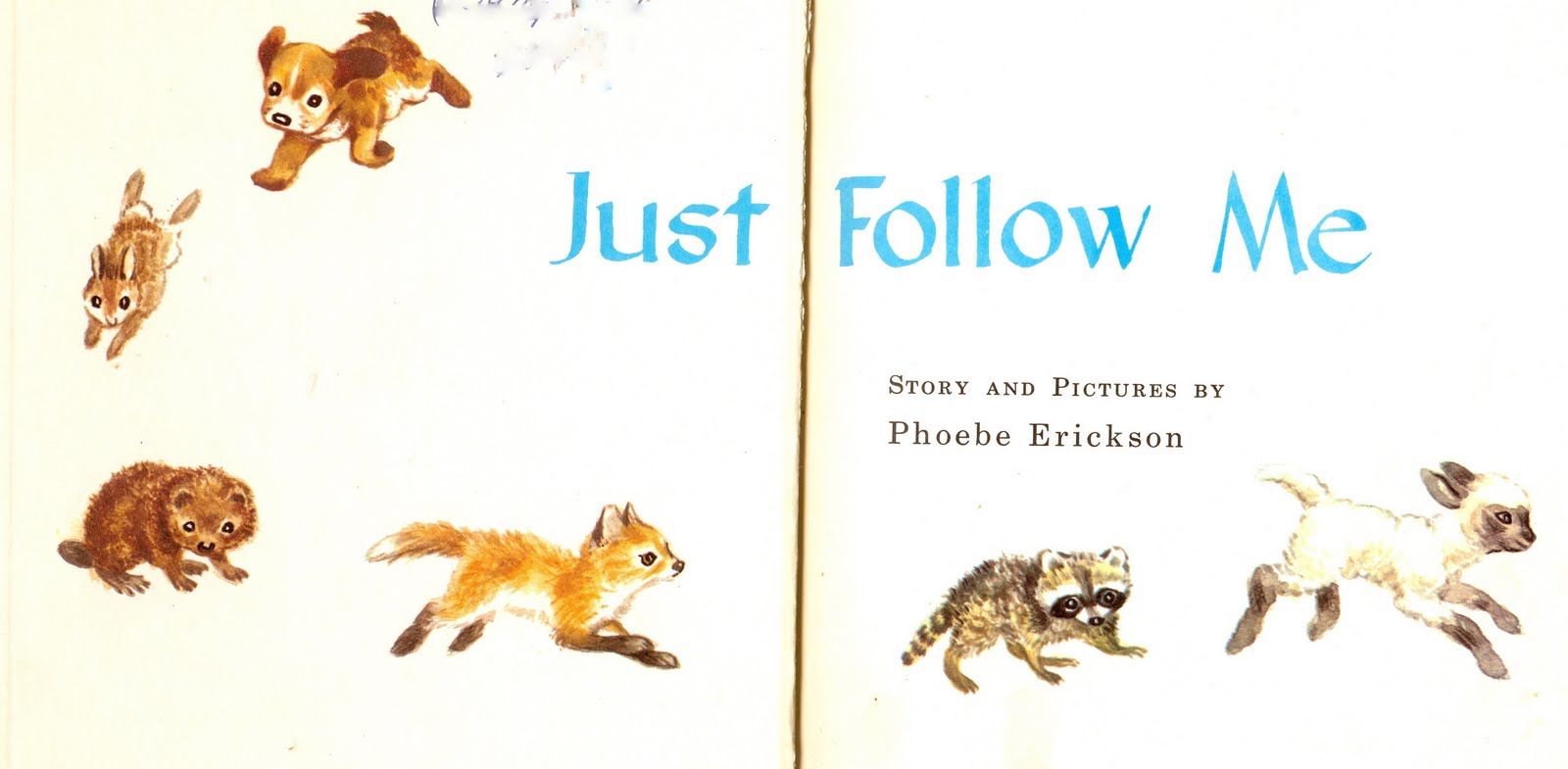
While I was reading this book, I was selecting books from my sister's library and came across Just Follow Me by Phoebe Erickson which is illustrative of Mickenberg's treatise:  the puppy explores a world that is much bigger than he is, meets a variety of animals who say "just follow me" while he learns to judge for himself what is and isn't a home, comes across a lamb from the flock of the home farm, plays equally with this very different animal, and goes home to a mother who has worried that he has been lost but "Little Dog knew he wasn't and never had been lost."  
In some sense this little book is a biography of the "flower children" and so many of my friends who travelled about and made foolish and wise choices while "looking for themselves" during our college years.   It is one explanation of how and why the radicalism of the 1960s grew out of the placid (and repressive) 1950s and how and why some children of the South marched for Civil Rights, although Julia cautions:  "It would be impossible (and far too reductive) to draw some kind of cause-and-effect link between childhood reading and the rebellions of the 1960s. Even so, the generational lines are not merely coincidental." p. 276

I highly recommend Mickenberg's Learning from the Left, which I read in the Kindle edition, to anyone with an interest in literature, history, American culture, education, or who seeks to understand the roots of the sharp political divide and partisanism which is the bane of current U.S. politics.  We might also read a some children's literature to see if we can  "strengthen a sense of community, of the need to work with others to solve problems."

01 July 2011

"Windows and Wallpaper" ChLA 1

I recently spent a delightful 5 days at Hollins University attending  ChLA; the hosts were wonderful, the sessions were educational, my fellow attendees were interesting and interested, the food was delicious, and there were fireflies at the awards banquet on the grounds of the historic quad.  All that and I got to be dorm "roomie" with Sonya Sawyer Fritz.  What fun!

The Runaway BunnyMargaret Wise Brown, who graduated from Hollins in 1932, is the author of two of my favorite books (Goodnight Moon and The Runaway Bunny)
and is being celebrated with a festival which has just opened.  The campus museum exhibit, where I spent a delightful half hour and wanted to stay the day, is Goodnight, Hush.  Classic Children's Book Illustrations. I lingered and returned again and again to the original illustrations by Clement Hurd.  Since DMP and I had a series of house bunnies spanning twenty years, I delighted in his studies of rabbits in various poses.

Papa Gatto: An Italian Fairy TaleI also enjoyed the classic fairy tale illustrations of Ruth Sanderson and bought a copy of Papa Gatto, An Italian Fairy Tale, a Cinderella story which required no fairy godmother. 
GoldilocksSanderson's illustrations are beautiful and draw one into the story.  If there had been a copy in stock I would have bought Goldilocks because the illustration reminds me of my young neighbor, Emily C.  After making my purchase, I returned to the exhibit to find the benches fully occupied by women with PhDs and tenure-track professorships.  Each had grabbed a book and settled down to read a story of her childhood. What a wonderful recess from the distractions of scholarship!

Word WizardThe first session on Thursday featured Children's Literature as Linguistic Play and a look at books where "conversation shapes social reality" and  I enjoyed learning about these very special children's books:  Max's Words, The Three Pigs David Wiesner's The Three Pigs at first seems to be the familiar story  but then the wolf huffs & puffs & blows the little pigs outside the story frame and away they go on a series of adventures (and changing illustrative style) into other story books.  It's a childhood version of Jasper Fforde's Thursday Next series which neither DMP nor I can resist for a minute.
The Eyre Affair: A Thursday Next Novel (Thursday Next Novels (Penguin Books))Lost in a Good Book: A Thursday Next NovelOne of Our Thursdays Is Missing: A Novel

The Hero with a Thousand Faces: Commemorative Edition (Bollingen Series (General))The Wonderful Wizard of Oz (Original Version)Adam Z. Dotson's presentation linked Frank Baum's The Wonderful Wizard of Oz to Joseph Campbell's The Hero with a Thousand Faces which defined the monomyth and has been required reading for any serious student of literature since it was first published in 1949.  A bit of fun as Dorothy manages all 17 points of the hero's journey although Baum's work predates Campbell's by almost half a century.  If you only know the movie, you've missed much of the story although I did not much enjoy the books when I read them as a child.  

Dotson's paper was lagniappe since I chose that panel because I wanted to hear Anna Panszczyk's paper "Get Thee to a Library:  The Library Setting as a Space of Revolt and Difference in Children's Literature" and Anna did not disappoint.  The library appears as a space of "hushed tones and rigid rules" where one obtains "immediate information" but its  "organized, ordered exterior" exists "in tension with the chaos at its heart" where there is a "frenzied passion" to "collect, hoard, and devour" books.  Anna's talk featured  Library Lion and The Librarian of Basra   and one of the most delightful books I've come across, The Libraryby Sarah Stewart about a girl who would "rather read..."  That girl is a lot like the child I was and the woman I grew to be.
The LibraryLibrary LionThe Librarian of Basra: A True Story from Iraq

The day concluded with a screening of The Library of the Early Mind, a documentary film directed by Edward J. Delaney, produced by Steven Withrow, which features interviews with 50 top writers, illustrators, publishers and critics of children's literature.

{Insert many adjectives for a rave review here!}

 The interview with Daniel Handler a.k.a. Lemony Snicket is a delight!

One of the interviewees (perhaps Peter H. Reynolds) said that children's literature, "the books we read as children... give us windows and wallpaper."  I think he meant "windows" through which to look out and learn of the world and "wallpaper" with which to decorate the rooms of our minds, the images on which our inner eye dwells. 
My quirky mind was pleased at what I think was an unintended double entendre:  Windows is also an operating system and Wallpaper is the image we select for our Desktop. One cannot consider books, reading, information, libraries without considering the changes that technology and digitization are bringing. 
Quoting my friend Luci's blog:  "...if you're a teacher... start imagining how you can transition your classroom to a multi-media, online format. don't worry, your organization's LMS should be a great help, and you can shoot for gradual blended learning if the online component freaks you out. but buck up, soldier - the technology is here to stay, people are already drawn to it, and it can add a lot of options to your class to help different kinds of learners, so make friends with the computer and let it help us turn out critical thinkers who're actively participating in their educations."

ChLA to be continued...