Showing posts with label memoir. Show all posts

01 February 2017

Bamboo: Symbol of the Upright Scholar

Making a few notes re. my birthday visit a week or so ago to the Museum of Fine Arts Houston with my dear friend since college days. We've been walking through that museum together for almost 50 years. Such a friendship is the best gift!

MFAH Emperors Treasures: Chinese Art from the National Palace Museum, Taipei

Cathey noted the dynasty changes and interactions with other world cultures. This was particularly noteworthy in the interactions of Taoist and Buddhist Emperors and the art they collected.
In the 14th Century, world trade gave Chinese potters access to Persian Cobalt and the pottery changed from exquisite white and pale green solids to blue and white that is now almost a cliché of Asian art.
 I noted how each emperor and the single empress appeared to demonstrate artistic taste and literary skill as proof of their qualifications to lead. The arts which the emperors both made (the royal calligraphy was done in a special red ink) and collected in some sense legitimized their reigns.
Each change of dynasty required those artists who were part of the court to decide whether they would remain loyal to the overthrown dynasty and lose their positions or whether they would support the new emperor.
We also wondered if art projects, especially the large pottery collections, might have been employment programs, an economic alliance, a sort of quid pro quo.
Funny how the past reverberates into the present. The day we visited Mr. Trump had proclaimed that he would not fund the National Endowment for the Arts and National Endowment for the Humanities. I wept.
I  noted a calligraphic quote from Kangxi, Emperor of the Qing dynasty, which may prove good advice for the times in which we are living:
"A kind edict: Heed rashness and persevere."

When I was a sophomore at Floydada High School, the world history teacher was Mr. O. W. Lewis who loved Chinese history. I was surprised and grateful at how much I remembered. I wish he could have walked through this exhibition with me.
I am grateful for so many teachers, past and present.
My very most favorite things were small painted cards that were made as gifts for friends: "Bamboo, symbol of the upright scholar." So the little public domain illustration at the top of this post is for all the "upright scholars" in my life.
I've always subscribed to the "don't draw what you can trace, don't trace what you can photocopy, and don't photocopy what you can cut and paste" theory of illustration. I fear I have little artistic talent like Kubla Khan who "expressed his artistic inclinations through appreciation."

Another great favorite was the gourd (also Kangxi, I think) which had been encased in a patterned wooden or ceramic mold so that as it grew the mold transferred the pattern to the gourd.  A difficult art combining both human artistry and the work of nature. Here is a link to a piece that is very similar if not the same one in the exhibit: http://treasure.chinesecio.com/en/article/2009-08/25/content_13735.htm

Let's heed poet Mary Oliver's quote and "think again of dangerous and noble things." Let's all strive to be "upright scholars" and "be improbable beautiful and afraid of nothing."
Remember, emperors live and die, dynasties rise and fall, but art and literature and things of "beauty are a joy forever." Let's save as much of it as we can.


17 September 2015

Sometimes I need a Yia Yia...


from Mrs. Beeton's Everyday Cookery
I am not feeling well today and what I really, really want is a huge bowl of Yia Yia's Chicken Soup from my favorite Greek restaurant which closed several years ago when the owners went home to Greece to care for an aging mother. I miss them, I miss the restaurant, I miss the herbed lamb souvlaki, but most of all I miss Yia Yia's chicken soup.

The healing powers of chicken soup are legendary. I was never really sure if it was the soup or the maternal hands that prepared and served it.

My own mother, an excellent cook, did not often make soups. She made stews laden with big chunks of meat and home grown vegetables. Her chicken and homemade egg noodles can warm a winter's night and right a world turned upside down.
Both my grandmothers cooked much like my mother. My maternal grandmother, Mary B. Wieland's German heritage added thick stews made with sausage and cabbage and beets and potatoes, lots of potatoes--all delicious but none serving much medicinal purpose.
We are a generally healthy clan with appetites to match and have little need for "invalid cookery."*

"Invalid" is an interesting word rooted {and now I'm down the rabbit hole} in the Latin, meaning"not strong" or "without strength" which in the 17th Century came to be used for the sick and infirm. It is a word that now may be considered politically incorrect, as are a couple of its synonyms e.g. "illegitimate" and "illegal."
Adjectives applied to people are increasingly at issue. I think that sometimes we use language to define, to limit, to stereotype, to divide, to disempower. Our words reveal our thinking of "them" as something other, of something less than I. It can say "you are not one of us, you do not matter." It comes as no surprise that people may be hurt (which might have been part of our intent) and may become angry and object to our attitude and to our words. Those "words that never hurt" can lead to  "sticks and stones" and suddenly the issue becomes political. To me it is seems less "political correctness" and more a matter of "treating others as you would like to be treated."
{Dear reader,  these rabbit holes and my compulsion to explore the world of words is one reason I never seem to get anything done. I've been lost in the dictionary, multiple cookbooks, a nursing archive, and the interwebs for hours. I usually call it research and I justify this excursion by noting that Evelyn Whitaker features many a sick room in her novels. In truth, I'm indulging myself because I'm not well.}

Returning to the subject at hand:
My husband's mother never enjoyed cooking and produced a brood of picky eaters who often prefer the pale store bought version to yummy homemade. David once said he thought it was "tragic that a cook of your skill and taste is married to a man who can so little appreciate really good food." His comfort food of choice is Campbell's Chicken Noodle Soup.
Campbell's out-of-a-can-with-too-much-salt-and-very-little-Chicken-with-overcooked-limp-pasty-Noodles-Soup that I find unbearably bland and barely edible. Nonetheless, there are always several cans in my pantry because "the healing powers of chicken soup are legendary" and an ailing husband must be comforted with chicken soup like his mother made.

I'm going to share a secret. The  woman who owned that Greek restaurant and made her Yia Yia's chicken soup said, "almost any soup can be turned into Avgolemono soup, even that nasty canned stuff can be improved with an egg and some lemon juice. Just remember to add lots of extra dill. Most of the recipes don't call for dill but that's how my Yia Yia made it and that's what you like."

Yes, I sometimes make Yia Yia's Chicken Soup using a classic recipe for Avgolemono (Egg & Lemon) Chicken Soup and I add dill, dried or fresh and lots of it. Like my Greek friend I may use the traditional pasta but "sometimes I make it with rice because you Houstonians like rice" and often I have rice already cooked in my fridge.
While I never had a Yia Yia, my soup is always very, very good.

1907 edition from my collection
Today I'm sick, much too sick to cook and I understand Mrs. Beeton's admonishment to ". . . give such food as affords most nourishment for the least work. . . ."* 
Especially when the cook is also the patient.

Needing the legendary healing powers of chicken soup, I grab that Campbell's can from the pantry. I put it in a pan and add half a can of water. Then I add a lot of dill, dried and handy in my spice rack. (Sometimes I add a dash of onion powder and some celery seed but not today.) While it heats, I separate an egg and beat the yolk very well. I whisk the juice of a lemon into the yolk. Temper it with hot broth, then stir it into the soup.  I sometimes strain out those limp noodles and I hope there's some crusty bread or a few croutons, but, whatever is at hand,  I eat and feel better.

*Here is link to the 1907 edition of Mrs. Beeton's Everyday Cookery. London: Ward & Lock, which is in my collection. Her advice for Invalid Cookery is on pages 107-109 and there is no mention of chicken soup.
Here is another link with recipes from those chapters from an earlier edition. I think I'll just skip the Eel Broth and the Rabbits Cooked in Milk.

{Dear reader, Yes! It is really research since finding this recipe may explain a rabbit included in the "Notices to Correspondents" of The Monthly Packet (Charolotte Yonge, ed.) 1884: "For the Buttercups Building Fund, gratefully acknowledged. Mrs. Barnett, £2; Stamps, 6d.; Lady returned from Berks, £l; N. H., 5s.; a Rabbit, 2s.; privately acknowledged, £3 16s.
Miss Whitaker, Hinton, Twyford, Berks"
Alas!
For those of us who visualized the bunny frolicking on the meadows lawn and being petted by sweet children, it may well have been so until it was prepared per Mrs. Beeton's recipe for invalid cookery.}

19 March 2015

Abandoned in a shoe box...

A few days ago, "my memory turning to lace" could not produce the name of a woman I met at the British Women Writers Conference 2010 and with whom I had had a lovely conversation re. Christian Rossetti. I know that all my conference notes are carefully put away somewhere. Where? Not found. In turning a closet and one room into a disaster area, what I found was an archival box labeled: "K To Do" which I had not seen since we moved in 2012. Oh, my! Most stuff went straight to recycle but buried away were some pages torn from spiral notebooks. I usually keep a notebook at hand to scribble random thoughts, notes, to do lists, my journal. When a notebook is full I rip out the scribble pages, put an end date on the cover, and put it on the shelf on my other journals. I am always left with a few things that need to be transcribed to one of my projects. Such were the items that I simply abandoned and forgot.

"Among those whom I like or admire, I can find no common denominator, but among those whom I love, I can: all of them make me laugh."  W.H. Auden (1907 - 1973) I have no idea where I read this quote or why I noted it. For me it's not particularly true. The paper indicates that I noted it in the early 1980s and also has a tree of computer commands that I think are probably for my first computer, a KayproII which David bought for me the first year it came out (1982) and I most happily used well into the 1990s until I finally had to give up and buy something that could run Microsoft Word.

"If my life was, in my view, finite, how would I change my life today? Today is finite. Indeed, each moment is finite. "Today while it is yet today..." Choose. Is my current choice the best choice for me? Is the continual laying aside (putting off) my dreams a lofty self-sacrifice for the greater good? Or, is it, in truth, a betrayal of myself? If I made the best choice for me, without regard for others, would I do more good, ultimately, for others, too?" The type of notebook page and the pen I was using indicate that this note dates much later, the late 1990s. The first sentence may have been a writing prompt (I'm fairly certain that I would have written, "if my life were... finite... It's one of my grammarly sore spots.) from some psychological and spiritual guru or self-help book that I engaged before or during my Jubilee sabbatical in 1999. Still a good question for me to consider.

Pages torn from another notebook (later, I think probably about 10 years ago) continue those thoughts about choices in a list:

  1. Go see Mother & Daddy 4x/year Fall Spring Since they moved to Clifton I have gone much more often and Daddy died last year. I think that four times might be a better choice for me than the every couple of months that I try to keep on my current calendar.
  2. ??? Ladies Bible Class  ??? Church Library both of which I have now intentionally cut from my life
  3. need to stretch muslces: hamstrings! calves! I still need to do that
  4. If someone told me what I'm telling me, I'd say, "Different times in life demand different priorities. It's okay to back off and do what you need/want to do for your family." I'd still say the same except "family" might be changed to "yourself."
  5. Mother and Daddy said, "You've been good your whole life, we think you should have fun." I remember when they said that. We were lingering over breakfast before I left Clifton to go home. Often when Daddy said bye to one of his kids/grandkids/brothers/cousins, he'd say, "you be good now." Mother interrupted him and said, "No, Kendall. Don't you remember what we said we were going to tell her from now on." And they said in unison, "You've been good your whole life, we think you should have fun." Made me cry then. Makes me cry now.

The crumpled edges of the ripped spiral holes of the next page are interlocked with the previous, perhaps indicating a response to my parents' instruction, and that page is another list titled What's Fun?:

  1. playing with Mandy
  2. puttering in my house & yard  plant flowers! birds!
  3. writing - my creative work
  4. reading
  5. daydreaming about my trip to UK
  6. music
  7. Rice baseball
  8. dinner parties

I could have written that list yesterday.

In 2000 as they do every four years, Weiss Tabletop Theater at Rice University staged an updated version of George Greanias's Hello, Hamlet! (1964) which David and I attended with classmates with whom we had seen the second production in 1968. The program from that production enclosed a  page from another notebook, from the time when I was using blue legal pads. In May 2003, we adopted Miss Mandy Whitepaws and I made a few notes for a musical a la Grenaias. Here is a list of songs to be adapted:
The portrait photo of Mandy
made three weeks after we got her.
Hello, Mandy! 
"Well, hello, Mandy. Welcome home, Mandy. It's so nice to have a dog where she belongs..." I still sing this one to her.
"I Enjoy Being a Dog..." to the tune of "I Enjoy Being a Girl" to be reprised as a duet "I Enjoy Having a Dog..."
"Crazy..."
"What Kind of Dog (Fool) Am I?"
"Look, I'm a Lassie tonight!" to "Luck, be a lady..."
"Some Bark, Some Don't" to Freddie Hart's Some do, some don't
"Bark, Bark, Mandy" to "Bye, Bye Birdie
and the grand finale
"Glory, Glory, Mandy Whitepaws (Hallelulja!)


Other items will be going back into the box for K To Do later.

16 March 2015

“All human knowledge takes the form of interpretation.”

Walter Benjamin. Clippings from a Google image search screen shot.
I have always been an opportunistic reader, reading whatever happened to be at hand. I am also a disciplined reader; give me a list of required reading and I read through it. (Always excepting Ulysses by James Joyce--I tried and tried and tried again. Three strikes and out.) First and foremost, I am a meandering reader. When I read a book that mentions a book, I often go find that mentioned book and read it. I adore footnotes and bibliographies where more books can be found. Some of my most influential books and favorite authors were discovered in this way. Reading and the discovery of books is for me a metaphor for life: interconnectedness, chance, and serendipity.

Larry McMurtry was an instructor, writer-in-residence, when I was an undergraduate at Rice University and I happened to be assigned to his section of English 100, 1967-68. At the time I was a science/engineering student or I would have missed that opportunity since potential English majors were assigned to English professors. Chance. Serendipity. Because I knew McMurtry, I  follow his career and read  his books, dutifully checking them off the list, although in general his books do not number among my favorites and I'm lagging behind the list.
I have always most enjoyed McMurtry's non-fiction:
   In a Narrow Grave: Essays on Texas (1968), Roads: Driving America's Great Highways (2000); Books, a Memoir; and my favorite Walter Benjamin at the Dairy Queen: Reflections on Sixty and Beyond (1999).

 So having read McMurtry, I read Walter Benjamin's Illuminations: Essays and Reflections . 
Interconnectedness. I read it slowly giving myself time to reflect and think.
Serendipity. I had read bits and pieces of Benjamin long before; my German professor was fond of having us translate paragraphs re. Kafka and Lestov. I had gathered a few English quotes for a paper on Kafka. Kafka is on my "do not like list" just ahead of James Joyce. While I do not share Benjamin's admiration for Kafka, I forgive him all those awful German paragraphs because he was my introduction to Proust.

Harry Zohn's translation with Hannah Arendt's excellent introduction was, and is, pure joy. A joy I had forgotten--Benjamin has a lot to say about remembering and forgetting--until I stumbled upon Maria Popova's Brainpickings: Walter Benjamin on Information vs. Wisdom which presents a nice selection of quotes with commentary on Benjamin's essay: The Storyteller: Reflections on the Works of Nikolia Leskov.
 http://www.brainpickings.org/2015/03/09/walter-benjamin-illuminations-the-storyteller/

The Mundaneum.  Cataloging the World:
Paul Otlet and the Birth of the Information Age.

I loved this early 20th Century photo!

Quoting Popova's blog: "The most dazzling such transmutation takes place in an essay titled “The Storyteller,” in which Benjamin uses the work of 19th-century Russian writer Nikolai Leskov as a springboard for a higher-order meditation on the role of storytelling in society, the dangers of its decline, and how it shapes our relationship to truth, both public and private. The picture Benjamin paints begins in darkness but reaches toward the light."

It is easy to see all the modern digital experience as interconnectedness, chance, and serendipity.
 My  favorites of Benjamin's essays are probably quite predictable to those who know me.
Of course I want to visit his library and learn about the life he reads:

"Unpacking My Library: A Talk about Book Collecting" jogs my memory. I have not yet finished Alberto Manguel's The Library at Night which has spent well over a year at my bedside. Somehow it was displaced and lies neglected but I look forward to the life I read tonight. Serendipity, indeed. And one of my favorite McMurtry books is also about collecting books.
Quoting Benjamin:
“I am unpacking my library. Yes I am. The books are not yet on the shelves, not yet touched by the mild boredom of order. I cannot march up and down their ranks to pass them in review before a friendly audience. You need not fear any of that. Instead, I must ask you to join me in the disorder of crates that have been wrenched open, the air saturated with the dust of wood, the floor covered with torn paper, to join me among piles of volumes that are seeing daylight again after two years of darkness, so that you may be ready to share with me a bit of the mood -- it is certainly not an elegiac mood but, rather, one of anticipation -- which these books arouse in a genuine collector.”
  
Screen shot of Google image search, March 2015

I had just begun to learn Hebrew so that I could better understand the biblical Psalms when I first read "The Task of the Translator" and realized that:
“All human knowledge takes the form of interpretation.”
 
"Fragments of a vessel which are to be glued together must match one another in the smallest details, although they need not be like one another. In the same way a translation, instead of resembling the meaning of the original, must lovingly and in detail incorporate the original's mode of signification, thus making both the original and the translation recognizable as fragments of a greater language, just as fragments are part of a vessel.”

 
Technical Reproducibility.
"The Work of Art in the Age of Mechanical Reproduction"  should be on every one's reading list. It anticipates and contributes to the discussion re. STEM and the humanities and why the humanities (history! literature! art!) are essential. Its relevance might be more easily recognized if the translation of the title had been truer to the German: "Das Kunstwerk im Zeitaler seiner technischen Reproduzierbarkeit" which Zohn revised to "The Work of Art in the Age of Technological Reproducibility" and I (with only my librarian's German) am bold to suggest "The Work of Art in a New Age of Technical Reproducibility." Given the very long time that art, literature, storytelling, history existed before the fairly recent advent of the scribe, the press, print, audio and video, digital ad inf. this Age is always New. The great thinkers of the past, like Walter Benjamin, help us navigate these uncertain waters.

“Every morning brings us news of the globe, and yet we are poor in noteworthy stories. This is because no event comes to us without being already shot through with explanation. In other words, by now almost nothing that happens benefits storytelling; almost everything benefits information. Actually, it is half the art of storytelling to keep a story free from explanation as one reproduces it. . . . The most extraordinary things, marvelous things, are related with the greatest accuracy, but the psychological connection of the event is not forced on the reader. It is left up to him to interpret things the way he understands them, and thus the narrative achieves an amplitude that information lacks.”  

“The value of information does not survive the moment in which it was new. It lives only at that moment; it has to surrender to it completely and explain itself to it without losing any time. A story is different. It does not expend itself. It preserves and concentrates its strength and is capable of releasing it even after a long time.”

“We do not always proclaim loudly the most important thing we have to say. Nor do we always privately share it with those closest to us, our intimate friends, those who have been most devotedly ready to receive our confession.”

The Stanford Encyclopedia of Philosophy notes: "With the outbreak of war in 1939, Benjamin was temporarily interned in the French “concentration camps” established for German citizens. On his release a few months later he returned to Paris and there continued his work in the Bibliothèque Nationale on The Arcades Project. The notes for his unfinished research were left in the safekeeping of librarian and friend, the writer Georges Bataille, as Benjamin fled Paris before the advancing German army in the summer of 1940. The last few months of Benjamin's life reflect the precarious experience of countless other Jewish Germans in Vichy France: a flight to the border and preparations for emigration by legal or illegal means. Lacking the necessary exit visa from France, he joined a guided party that crossed the Pyrenees in an attempt to enter Spain as illegal refugees. Turned back by customs officials, Benjamin took his life in the small, Spanish border town of Port Bou, on September 27, 1940."


What a horrible loss to all of humanity!
Blame the Nazi Holocaust.
Blame the petty bureaucrats at the border.
Blame ourselves because we never seem to learn the basic lessons of compassion and peace.

“In the end, we get older, we kill everyone who loves us through the worries we give them, through the troubled tenderness we inspire in them, and the fears we ceaselessly cause.”

Oh the back roads of Texas, I never stop at a Dairy Queen without remembering McMurtry and Benjamin and meandering through the life I read.

16 February 2015

South Plains School


1925 photo of Sunset School, housed in a wooden building. 
I attended a rural school in Floyd County, Texas, and several years ago created a facebook group for  the South Plains School Alumni & Community.
Today one of the discussions took a bit of a  turn from remembering and honoring a community member who had died to a discussion of the school's history.
As it happened, a bit later in the day I came across an envelope of newspaper clippings from May 1988 when the school closed. It "was the last rural school in Floyd County and one of only seven in Texas." At one time there were 32 rural schools in Floyd County.
My family had attended South Plains School for three generations and we had family connections going back four.

The school  "opened in 1895 as Sunset
School, district number eight," in a one-room, wood frame building located 2 miles east of South Plains. Children walked, rode horseback, or came in buggies to attend. John Wilson, the oldest student of the school still living in Floyd County at its closing, started school at Sunset in 1914. They carried lunches (cold biscuit and sausage) in a syrup pail. He remembered "the big rain of 1919... which filled the draw west and south of Sunset from bank to bank." The teacher thought it unsafe for the students to cross the flood and sent them to nearby homes of Grigsby Milton, Sr., Charlie Wilson, and Mrs. Vera Snodgrass.

Top and bottom are views are 1927 photos of the brick Sunset School.
The middle view is the flat-roofed South Plains School,
rebuilt from those bricks. I attended that school
from the first through eighth grades.
"In 1926, a brick school building was erected one mile north (farther from that draw) from the original school. It was large for its days, containing eight rooms where an enrollment of 180 students studied. They ranged from primer to tenth grade." This new brick school building was I think located on the southeast corner of the half section homestead of my grandparents, Zach Carter and Oma Calahan Cummings. Her younger sisters and brothers attended the school. I think members of his family also attended Sunset School.
I think this building was also the first meeting place of the South Plains Baptist Church of which my great grandmother, Lala Delilah Shelby Calahan, was a member.
The location of new Sunset is marked by an electric substation on land still belonging to my family.
The Fort Worth and Denver Railroad arrived in 1927 and the town of South Plains was located platted on the railroad halfway between Floydada and Silverton, the county seats of Floyd and Briscoe counties, and an equal distance from Lockney. The Sunset community decided to "dismantle" and move its school to the new town. "Noel Deavenport, one of the students in all three schools--old Sunset, new Sunset, and South Plains--remembers helping clean the brick when the school was rebuilt." I can remember hearing my great uncles (Shelby and Junior Calahan) tell that same story. The South Plains school opened in the fall of 1929 with 133 students which would be the school's peak enrollment.
I have been gleaning information and quoting an article by Neta Marble and Jim Reynolds, The Floyd County Hesperian, Volume 92, Number 25, Thursday, June 23, 1988 published upon the closing of the school and its students going to either Lockney or Floydada.
Neta interviewed my father, Kendall K. Cummings, for that article. He attended ninth and tenth grades at South Plains School following the consolidation with Roseland School in 1935. (He had started school at Roseland. Yes, he rode a pony. Then attended school at Lone Star before moving back to Roseland. At that time South Plains offered only ten grades.
Quoting Daddy: "Well over a hundred students were enrolled. We had six rooms and there was somebody in every room." He adds that some students from Cedar Hill were also attending South Plains. "They were trying to get the school accredited with a full high school then, but it went the other way." Two years later, South Plains School "was cut back to nine grades."

After Daddy's graduation from South Plains in 1937 (we have the commencement program), he attended an additional year and graduated eleventh grade from Lockney High School in 1938. His younger brother, Sterling, and his sister, Delilah,  would follow in his footsteps.
The younger siblings, Mona, Jean, and Zach W.,  attended high school in Floydada.
By the time I attended South Plains School, it had only eight grades.

1988 photo Dallas Morning News, last days
It was cut down to six grades and had only twenty-seven students enrolled before it closed in 1988.
My brother's children, Kendall II and Victoria, had just finished the fifth and the second grades. She is the girl in pink on the left. He is the taller blond boy in the black and white shirt, at the back, fifth from the left.
There was a reunion-homecoming to mark the end of the era. I flew home for the party. We had one of those rare "big rains" and couldn't get there for all of the events. We were able to make the party for which my mother had baked dozens of cookies.

Newspaper articles were published in the Lubbock Avalanche-Journal, Saturday, May 28, 1988 and in The Dallas Morning News, Sunday, May 29, 1988. I think there was some TV  coverage.

My aunt, Margaret Calahan, painted a picture.


My mother wrote a poem:


On the closing of South Plains School
1928 - 1988
by Dorthy Wieland Cummings


Country school stands in a bed of weeds.
Time has come!
No school smell--glue and sweaty kids.
The walls listen and long for laughter.
Hallways, missing footsteps
      of boys and girls
          running through,
                 happy skips of young feet.
Dead silence.
Where are they? Oh, where?
Gone!
           No more!
                         Forever...
                                         Just
                                                 dead
                                                             silence.
Memories live.


29 January 2015

“Deep down I know I could never be that innocent again..."


World Toys and Gifts where I listened to their story...
“Deep down I know I could never be that innocent again, however much I'd like to be.”  
This quote and others in this blog are from Anne Frank's The Diary of a Young Girl.
When I first read this book I was a freshman in high school and the same age as Anne was when she was writing. I finished it with sobs and immediately read it again.  I gave myself completely to the book.
 “If I read a book that impresses me, I have to take myself firmly by the hand, before I mix with other people; otherwise they would think my mind rather queer.”  
 I was of course reading the original version, the only one available at the time.  I have recently read the 2010 "diary as Anne Frank wrote it" that includes the approximately 30% of Anne's diary--largely those sections dealing with her sexuality and her conflict with her mother--that were excised by her father Otto Frank. (And who can criticize a father who wished to preserve the innocent child that he would never see as an adult?) Nonetheless, the young teen reader I once was would have identified with those issues. The recognition of sexuality and maternal conflict are hallmarks of female adolescence and neither Anne nor I were exempt. During the time that I read the original I was quite depressed and I am not over stating when I say this book and taking Anne's advice saved me:
 “The best remedy for those who are afraid, lonely, or unhappy is to go outside, somewhere where they can be quite alone with the heavens, nature, and God. Because only then does one feel that all is as it should be and that God wishes to see people happy, amidst the simple beauty of nature. As longs as this exists, and it certainly always will, I know that then there will always be comfort for every sorrow, whatever the circumstances may be. And I firmly believe that nature brings solace in all troubles.”  
{How I wish that I could be certain, as Anne was, that "the simple beauty of nature" would "always" exist but I have also read Rachel Carson, Annie Dillard, and a host of environmental writers and am quite aware of our assaults on the earth that savage habitats while our haze and blazing light darken the sky and dim the stars.}
At a time when my faith was most weak, Anne Frank was one of my best teachers:
“People who have a religion should be glad, for not everyone has the gift of believing in heavenly things. You don't necessarily even have to be afraid of punishment after death; purgatory, hell, and heaven are things that a lot of people can't accept, but still a religion, it doesn't matter which, keeps a person on the right path. It isn't the fear of God but the upholding of one's own honor and conscience. How noble and good everyone could be if, every evening before falling asleep, they were to recall to their minds the events of the whole day and consider exactly what has been good and bad. Then, without realizing it you try to improve yourself at the start of each new day; of course, you achieve quite a lot in the course of time. Anyone can do this, it costs nothing and is certainly very helpful. Whoever doesn't know it must learn and find by experience that: "A quiet conscience makes one strong!”  
Decades later I would learn that a Jewish teenager had been my first teacher in the Daily Examen of Ignatian spirituality.

Having  revisited the friend of my youth, I am now considering reading  her other writings. This link is worth clicking to look inside and see the wonderful photographs (from the Peter Harban's hardcover edition) of Anne and of her handwriting.
I think I would like to also consider Anne Frank as a feminist writer. “And now I have a question for you. 'Do you also put clothes on the flowers you've picked and refuse to talk about their delicate parts? I don't think there's a very big difference between people and nature, and since we're also a part of nature, why should we be ashamed of the way nature made us?”  

Houston is home to Holocaust Museum which I have not visited and may never visit despite the fact that I worked with and greatly admire Dr. Milton Boniuk whose name is on HMH Library and who, with his wife Laurie in memory of their son, founded Rice University's Boniuk Institute for the Study and Advancement of Religious Tolerance.
I don't go  because I am convinced that I have a very good sense of the horror and  just hearing or saying the word "holocaust" roils my stomach and can give me nightmares for weeks.
I don't go because I heard the first hand account of the two lovely sisters who ran World Toy and Gifts that is pictured at the top of this posting.
This street view no longer exists, torn down, gentrified, gone to all but those of us who remember.

 I spent countless hours visiting the Rice Village; my first off-campus date with DMP was probably at the theater. I seldom walked to the Village without stopping at the toy store. I loved the things of childhood and the respite a good browse brought from academic stress. I often bought small gifts there for my friends because even adults, maybe especially adults, need the pleasure of play. Mostly I dropped in to say hello to the elderly sisters I had come to love.
Once I brought them Valentine cookies that I had made. They reminded me of Grandma Wieland.

I never knew their names. They weren't posted anywhere. I doubt they knew mine; my purchases were always small and in cash. By the time our relationship had grown into a friendship it would have been awkward to ask or perhaps we were just past the need for naming.

We chatted; they were always asking me questions about where and how I grew up.
They laughed and shared happy childhood memories.
They learned my mother's family was German and that they had come to America in the 19th Century, "so before the war?" They asked that question more than often.
They asked about what I read, what I studied, what I thought.
"Have you read Anne Frank's Diary?"
Then one day they rolled up their long sleeves; they wore long sleeves even in Houston's hot, humid summers. Even when the store was warm and stuffy.
The older hesitated and the younger prodded her, "Sister, we decided... you know... we must tell the story."
Their arms were tattooed with numbers.
The older sister would not meet my eyes. She said, "You understand what this means."
"Yes, a concentration camp during the war."
And then she said she was "ashamed" of the numbers and what it meant. These dear ladies were ashamed to have survived when others had not. And it broke, it still breaks, my heart.
Over the next several years whenever I visited the toy store and there were no customers, they shared their story.
I listened.
Sometimes they lapsed into German which I understood only in bits and pieces.
Twice they sang songs to each other.
Sometimes we cried.
I have few regrets but I deeply regret that I did not go straight back to my dorm room and write down every word of their story me.
I too often choose the demands of my daily ordinary life over what is truly important.

I no longer remember their words but I will never forget the sound of their voices, the burden of their grief, the way the older would shake her head, the way the younger would pat her arm, the way they wrapped one arm around each other in a sort of sideways hug to get them through the ugly details.
That is why I will not visit HMH. Because I know there are many voices telling the story of the Holocaust because we must not forget but I want to remember their voices, the voices of two sisters.
The voices of my dear friends telling the story that was uniquely theirs.

Although in truth it was not much different from many others.
Not much different from Anne Frank's:

 "Jews and Christians wait, the whole world waits, and there are many who wait for death...”  
“No one is spared. The sick, the elderly, children, babies, and pregnant women - all marched to their death.”   

“...don’t believe the war is simply the work of politicians and capitalists. Oh no, the common man is every bit as guilty; otherwise, people and nations would have rebelled long ago! There’s a destructive urge in people, the urge to rage, murder and kill. And until all of humanity, without exception, undergoes a metamorphosis, wars will continue to be waged, and everything that has been carefully built up, cultivated and grown will be cut down and destroyed, only to start allover again!”  

“If we bear all this suffering and if there are still Jews left, when it is over, then Jews, instead of being doomed, will be held up as an example.”

“Look at how a single candle can both defy and define the darkness.”  

 “How wonderful it is that nobody need wait a single moment before starting to improve the world.” 

20 January 2015

"...that little newspaper..."

Greeting me on my 66th birthday, Baby Sister writes: "My most favorite memory out of MANY, is time you spent reading aloud to me. "Little Women", "Jo's Boys", that little newspaper....shoot, even the funny papers. . . Whatever you read to me came alive. "
Pretty close to my favorite memory also.

January 1949
my birthday month
The "little newspaper" was Capper's Farmer which usually arrived weekly just before noon in Thursday's mail--Rural Free Delivery. We were not allowed to read it until Daddy had finished it. For some reason, the male of the household required a "virgin" newspaper. I know this practice was not only our house rule because it is part of the comic routine of the BBC's "As Time Goes By" which DMP and I greatly enjoy. Twentieth Century movie clips and photos of the family breakfast table often feature the man of the house with a pristine newspaper. I noticed it on several episodes of  Downton Abbey.  The rule which I often considered unfair worked to my advantage since Friday was test day at school and Thursday evening was needed for review but my weekend reward was Capper's Farmer.


Arthur Capper published his weekly beginning in 1913 to inform "dirt farmers" and to support his political ambitions. He served Kansas as governor 1915-1919 and in the U. S. Senate 1919 - 1949. Scion of an abolitionist family, Arthur Capper was first president of NAACP in Topeka. A leader of the Farm Bloc and co-sponsor of the Capper-Volstead Act, he could attract controversy.

I first came across my favorite example of such controversy in this 1922 article from JAMA Vol. 79 No. 17 when doing retrospective bibliography as a medical librarian in the early 1980s. The link is to the only free source I could find on the net. In my youth I remember being shocked, amused, confused by some of the advertisements to be found in the back of such publications. Cures. Quackery. Devices. Pills. Potions. A primer to all the "we don't talk about those things."
 Arthur Capper died in 1951, the year my baby sister was born so "that little newspaper" which I would be reading to her several years later was no longer the product of his hand.
1949
I suppose Capper's Farmer which published through 1986 must have included serious articles about farming methods, issues, and politics of interest to my father but what I remember are the fillers and the articles meant for the farmer's wife.

Recipes. Canning tips. Gardening guides. Dress and quilt patterns.
Short poems.
Quips. Quotes. House plans.

The quilt patterns live on in the quilting blogs like this one.
http://quilthistorytidbits--oldnewlydiscovered.yolasite.com/cappers-weekly-and-the-queen.php

I have my mother's cookbook which is full of clippings, many from the pages of "that little newspaper."
 
1960
I remember this cover.

Two examples that I remember:

"Take pride in compliments but keep this tip close by:
flattery is mostly soft soap
and soft soap is mostly lye."

"We eat what we can and what we can't we can."
Which was always worth a smile during the long hot summers when we ate whatever the garden was "making" and spent countless hours shelling black eyes and beans, shucking and silking corn, peeling tomatoes or peaches while wishing for a bit of cool in a kitchen filled with pots of boiling water. No air conditioner for many of those summers.

For Baby Sister and me, Capper's weekly was all about serialized fiction. In fact, most  magazines in our house were valued for the serialized fiction. We adored the simple romance and the thrill of gothic. On those long lazy afternoons and evenings when I read aloud until my throat was too sore to read, we grew to know and love Mary Stewart, Victoria Holt, Nora Roberts, and a host of lesser writers whose names we never learned.
Our most favorite of such stories was published not in Capper's but in The Ladies Home Journal.
In April 1960, I was 10 years old; Baby Sis had just turned 8.  Seems a bit young but we may have read it some years later from a back issue; I know we read it over and over again.
Eleanor Hibbert writing as Victoria Holt, The Mistress of Mellyn.
Decades later I bought a first edition and read it aloud again while we made a long car trip together.

Arleigh's great blog with pictures of LHJ April 1960 issue is well worth visiting.

05 November 2014

Poppies

Photo by Linda Rucker Woodall. 2014
Today there are news stories about the 888,246 ceramic poppies at the Tower of London, "Blood Swept Lands and Seas of Red" by Paul Cummins.  I showed the photos to my mother and was not at all surprised when she recited the John McCrae's poem.
I was surprised by an interesting variation in the wording. She replaced the line "to you from failing hands..." with "to you from foreign lands..."
Mother says she first read this poem sometime before she was nine years e.g. prior to 1936 in a booklet prepared to honor U.S. military from Leon County who had served in WWI,
She is unsure when she memorized the poem.
McCrae was a Canadian and his poem was used in both Canada and the USA to inspire enlistment in the military during WWII.
Was "foreign lands" a mere slip of her tongue or memory?
Or, was the poem slightly altered in the version she saw as a child or in versions she may have seen later as part of a campaign against American isolationism?

Link to several photos. http://www.dailymail.co.uk/news/article-2822135/Don-t-away-incredible-Tower-London-poppies-people-chance-says-Boris-Johnson-plea-not-dismantle-display-week.html

07 May 2014

Memoir: Daddy on a summer morning...

I've been putting in a new yard. When I started removing grass to prepare a new bed, I noticed that my hoe was dull. I remembered the countless mornings from the time school turned out in May until School started in September--yes, we pretty much kept to those dates because in a rural farming community children are labor--that began with "iron sharpening iron" as Daddy filed our hoes and the rising sun colored the eastern sky and tinted the land rose gold.
I could not find my file so I asked DMP to pick one up on the way home. He did and when I opened the package in the morning light to begin a day's work, I finally got the joke.
Daddy had brought home a new file and laid it carefully on the edge of front stoop as he began using the old file on our hoes. Mother came out and sat on the stoop with her coffee cup watching him. Hiding his smile under the wide brim of his hat, he said, "Dot, hand me that S.O.B."
She shot him a look of both shock and anger.
His blue eyes sparkled and he looked directly at her and said, "That's what it is; read the label."
She did; they laughed. She blew him a kiss and tossed him the file and we got on with our day.
Even at the time, I knew they had shared a joke, a private joke, one of the countless little ways they affirmed their love day in and day out.
My new file is a Nicholson 10" Black Diamond Single Cut Bastard.
"Single Cut Bastard." What a wonderful phrase!
It would make a good line for a poem or a title for a novel.

04 May 2014

Chiaroscuro: Playing with light and shadow

I've had a week of experiencing light and shadows.
Making the most of Houston's last cool weather before the summer blast, I spent lots of time working in my yard. While working in the hot afternoons, I often longed for some rest in a patch of shade. The patio table umbrella was nice; the natural shade from my neighbor's trees was nicer. For me, those shadows became a place of shelter, a resting place.
Gregory Gibbs, 2014, used by permission.
One day last week a young friend posted a "selfie" that I found quite intriguing. I lingered over the photo and returned to it several times in the week. Something in the photograph reminded me of a Rembrandt painting that had first fascinated me in childhood when I found  it in the World Book Encyclopedia. Rembrandt's single candle lighting is called chiaroscuro. Chiaroscuro was not original to Rembrandt. Several of my other favorite 17th and 18th Century painters--Leonardo Da Vinci, Peter Paul Rubens, Caravaggio--made use of the technique. Chiaroscuro lends a painting "dramatic intensity, rhythmic visual harmony, and psychological depth." {I would very much like to properly cite this phrase but am not certain where it originates. Two sources that I found interesting are:  Jeffrey A. Netto's 1999 article for his English course: Writing in the World of Painting   and a really fun power point from teacher web "Outside the Lines." }

All this to say that I had already been thinking some about light and shadow when I arrived at The Cenacle Retreat House on Saturday morning for the "spiritual spa day." 


My friends, Amy, Chelsie, Brandy, Michal, Luci, Elana, and me
on the patio of the Cenacle in light and shadow.
I was very much looking forward to a massage to  ease the aches and pains of the week's hard labor in the yard, to being indulged with some delicious lunch and a high tea, and to spending some quality time with friends. It was a truly wonderful day. Walking the beautiful gardens and woodlands allowed me to experience more light and shadow.
One of the two sessions I attended was Connie Longsworth's Musica Divina, a meditation technique similar to Lectio Divina using music rather than text. Connie suggested that we could use this technique not only intentionally but any time when we were trapped listening to music in a car, on hold, shopping. We could use it for any genre of music, as a way of encountering God in everything.

I did not care for either of Connie's selections: Captivate Us by Watermark and Cyndi Lauper's True Colors. I found the music uninteresting; I found the poetry, particularly True Colors, dreadful. Nonetheless, as I reflected on the words and the relationship of those two pieces to each other, I noted that both songs were very sensory, extremely visual, and that both relied on motifs of light and shadow.
"like the stars..." "radiant bright... in your breath and shadow..." "let everything be lost in the shadows of the light of your face..." from Captivate Us
"You can lose sight of it all and the darkness inside you..." "I see your true colors shining through..." "Like a rainbow..."
from True Colors
My journal notes:
Chiaroscuro
by K Cummings Pipes 2 May 2014
Light by its very nature creates shadow.
Shadows are not the same as darkness.
Darkness is an absence of light.
Shadows are the result of light's presence;
they are part of the light's revelation.
For example:
I do not, I cannot doubt unless I first have faith.
Indeed, doubt is not the absence of faith;
doubt is a shadowed faith.
The presence of the Light reveals shadows.
Shadows change with the movement of light
or with the movement of the object that casts the shadow.
Remove the object and the shadow is gone.
Such removal may be necessary
when the shadow is the result of some hindrance or sin in my life.
Not all objects can be moved;
they are not sin but circumstance.
These objects are to be walked around, not stumbled over.
Sometimes a shadow object can become a candlestick,
lifting the light higher and increasing illumination.
Looking at a shadow from different angles,
seeing how the shadow changes in time and space,
may create a fresh perspective or open a new path.
If there are no shadows, there is no Light.
The play of the Light and shadows bring
"dramatic intensity, rhythmic...  harmony,
and psychological depth" to my life
and are indeed a shelter and a resting place.

18 October 2013

"...for keeps..."

I hosted two dinner parties last week: an evening party with a group of friends who have gathered monthly for what must be at least a quarter century and a ladies luncheon in honor of David's mother's birthday. As we walked Betty to her car, I bemoaned the fact that I had once again failed to snap any photos of the event other than those I took of my table before the guests arrived. Betty replied, "Well, at least you got the most important shot." She was perhaps being a bit sarcastic. Or not. She is an old school lady of the South and understands about silverware.

I almost always manage to get a pic of my table setting but I'm so busy serving the meal that I never again think of grabbing a camera. {Sigh!}
I'll comfort myself with the thought that perhaps I'm just so entirely "in the moment" that I don't think of preserving the history. I do not much like to have my own photo taken so perhaps I'm being a considerate hostess. Yeah, let's go with that until I have serving staff--a butler, a footman, and a maid in a crisp white apron. Oh, yes! I do love the dining room in Downton Abbey. David will tell you that he once had to drag me out of shop in New Orleans that had a beautifully set dining table to seat twenty-four. "Nothing succeeds like excess."

For those readers who are not of the South, I pull a couple of books from my library, both funny but in many ways oh-too-true:


I particularly enjoy "Chapter Four: Silver Patterns" in Schwartz's book, p. 41 which describes Betty's "Rosepoint. Wallace International. Old-fashioned girls pick this pattern." It's my secret favorite sterling pattern. I might have chosen Rosepoint if I hadn't picked my silver pattern before I started to first grade.

From the opening paragraph of Being Dead: "Polishing silver is the Southern lady's version of grief therapy. [They] have a thing about polishing silver.... Maybe it has something to do with an atavistic memory of defending our silver from the Yankees, but it does ensure that the silver will be sparkling for the reception, which almost always follows a funeral."

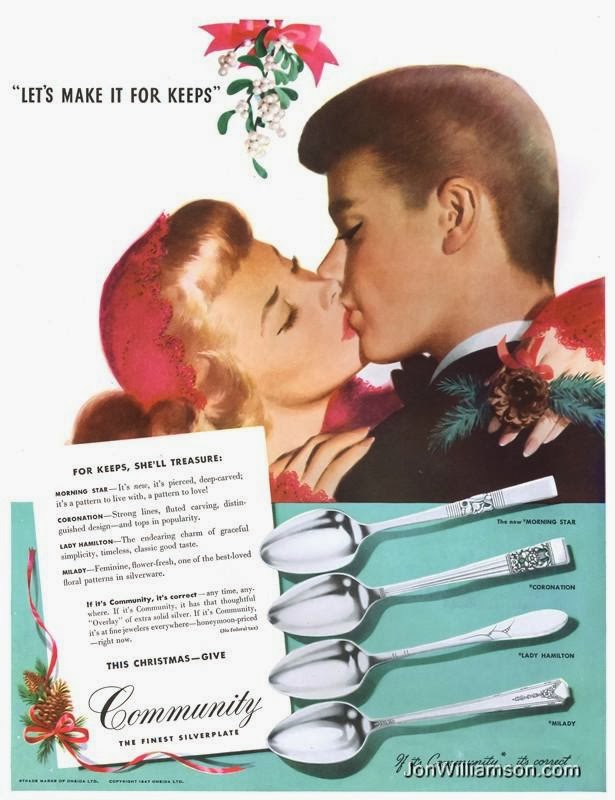
My love for silverware predates my learning to read. Stacked under a table in the my grandparents' bedroom were magazines, mostly dating from WWII through the very early 1950s, which pre-school me leafed through. Since I could only read a few words, I was mostly looking at advertisements and making up stories about the pictures. My favorites were the Community silverware ads.

This is probably my all-time favorite image via http://envisioningtheamericandream.com/2012/05/29/victory-homes-for-the-vet/


"You hear his special footsteps (glory be that's your heart pounding). You see his special smile (he's been saving it for you). Your head finds its home-place on his very special shoulder. It's true--praise be--it's true--he's home for keeps...."
These ads were really very short romance novels, popular pin-ups for "the girl he left behind," and undoubtedly foundational to the weaving the American dream. The illustrator/artist for these ads was Jon Whitcomb 1906 - 1988.

The words "back home for keeps" were easy to read and some of the first I learned but I loved this ad with its dark-haired beauty and her sergeant in an army uniform because it reminded me of my parents' love story. Their courtship spanned his enlistment in the Army Air Corps and they married in 1947. At the end of each date she would say, "Gimme your dimes." He'd pull the change from his pocket and pick out the dimes, adding them to those she had collected. They were saving to buy their silver.

 They bought Milady which is the pattern near the bottom of the ad and was frequently featured in Community advertisements. I grew up using this silver--yes, every day. I still have a spoon from the original service. For my parents' 60th wedding anniversary I shopped eBay and bought them a almost-good-as-new service. Mostly as "show and tell" for their grandchildren. I also collected several pieces and make frequent use of the iced tea spoons, the soup spoons, the butter spreaders which are great for soft cheeses, and a few forks when my entertaining ambitions exceed my sterling.

Milady was one of the first few patterns to come back into production following WWII. Whether a bride selected silverplate or sterling, most got promises until several years after the war. Oneida Ltd. (Yes! Oneida Community) manufactured this high quality silverplate and continued to advertise it through the war years but the plants had been retooled to make surgical instruments, combat knives, ammo clips, and shell casings,  for the war effort as they had done during WWI.

The company had emerged from the Great Depression as the only profitable silverware manufacturer and would lead the way in the 1960s to the move to stainless steel flatware for home use.

Community/Oneida had other ad campaigns.  "These are the things we are fighting for" was much like the more famous "Four Freedoms" series by Norman Rockwell.

 The "Back Home for Keeps" series would give way to the post-war "Let's Make It for Keeps" which was also a favorite of mine. "The Happiest Brides have Community" is undoubtedly a true statement and it's great advertising but I was not too fond of that series; most of the illustrations were of a bride only. Somehow I always thought the guy was more important than the wedding or even the silverware.
Christmas advertisements frequently pictured multiple generations. The bride's mother and grandmother might also be dreaming of setting her table with Community silverplate. 

Gran Cummings set her table with Oneida's Vernon silverplate.
Her pattern was Romford. 


I was delighted to shop for and gift my God daughter with her grandmother's Community silver.
The pattern is Old Bess.


Most of today's brides select stainless. Most people entertain casually. One young friend presents beautiful tables using her collection of Fiesta pottery. I always enjoy such gatherings. But it is not my style. This is my style:
 
The salt and pepper shakers graced Gran Cummings's table.
Silver: Prelude by International. 1939
China: Colburn by Noritake. 1960 - 1988
Crystal: Boopie by Anchor Hocking
The turquoise plate is the first thing I bought at an antique auction.
 
I sprinkled the pedestal tray with flor de sel because a bit of salt makes the good chocolate bloom.
The words we read and the illustrations we admire help shape the people we become. I was perhaps overly influenced by those Community advertisments. As a child, I had no idea what it meant to be married but I was absolutely sure it involved good silver.


Scroll through this small gallery of my favorite "for keeps."